Monday, August 25, 2008

ON ASSIGNMENT: IRAN FOR PBS


Friday Prayers in Tehran, July 2008

I have just returned from assignment in Iran for PBS Frontline World Rough Cuts. I am going to be a little mysterious about the story. It's fundamentally about the intersection of faith and science. I guarantee you will be surprised with what we found there. PBS will run our story online sometime in October.

In the meantime, here's a flickr gallery of some of our adventures.

'INDIA'S MISSING GIRLS' WINS SAJA NEW MEDIA AWARD


My wife and I were honored to even be considered for a new media award from the South Asian Journalists Association. We were blown over when our little movie, India's Missing Girls, actually won.

2008 SAJA Awards List

POLYGAMY: A WORLD APART


Watch CBS Videos Online

April 3, 2008 -- Texas authorities invaded the compound of a polygamous Mormon sect and took more than 400 children into custody on fears of rampant sexual abuse and underage marriage. The Fundamentalist Church of Later Day Saints, or FLDS, struck back, accusing the state of kidnapping their children without cause or due process. They dared Texas prosecutors to present evidence of sexual abuse and fought their case all the way to the Texas Supreme Court, whose decision would hold the future for an entire generation of FLDS children.

Field Produced for CBS News / 48 Hours.

Wednesday, March 12, 2008

WHO KILLED KENT LEPPINK?


In 1996 Kent Leppink was found dead on a small trail 90 miles south of Anchorage. He was shot three times at point blank range, no evidence how he got there or who killed him. But as police looked into his private life they found a tangled web. His fiance, Mechele Hughes, an exotic dancer at the Alaskan Bush Company, seemed to be engaged to two other men, at least the men thought so. At times Mechele lived in the same house with two of them, although not always the same two.

Police soon found a million dollar insurance policy on Kent's life naming Mechele as the beneficiary. And a strange letter written by Mechele and John Carlin, one of her other fiances, appeared to have lured Kent to the small town in which he died.

But with no physical evidence connecting anyone to the crime, it sat unsolved for 11 long years.

Since then Mechele has become a model PTA mom. She got a masters degree, married a doctor in Olympia, Washington, and has an eight-year old daughter. She is active in her school and church. She adamantly maintains her innocence and claims she has done nothing by try to help the investigation.

But Alaska's new cold case division is still gunning for Mechele and with new computer forensics and shocking new testimony they believe they finally have a case.

Love and Death in the Wild.
A 48 Hours Mystery

Tuesday, March 11, 2008

VIETNAM CULTURE BY THE GLASS


Over the last few years Vietnam has exploded as a serious foodie destination. From savory noodle broths to French infused pastries, the national cuisine seems to have it all. But for all good food there must be drink. And for the thirsty traveler, open to a few strange pit stops and the occasional tingling lips, a journey into Vietnam’s heart through its high-octane elixirs will not disappoint. It is this promise that recently drew my wife and me on a two week journey from the nation’s southern canals to its frigid northern mountains.

Most Emailed New York Times Travel Story Week of March 8th.

Read the New York Times Story
View the New York Times Video

Monday, January 28, 2008

VIETNAM PHOTOS


Not exactly reporting, well not yet. My wife and I recently traveled to Vietnam, mostly for vacation, but partly for an upcoming New York Times travel story.

Here are some of the shots

Sunday, January 13, 2008

NYT: ALZHEIMER'S, THE RAREST GENE


One family's deadly struggle with early-onset Alzheimer's has given scientists a window into the disease and its genetic origins.


When Chuck Jackson was only fourteen he was forced to nurse his 44-year-old mother through Alzheimer's. Now, at 53, he has it too. In fact much of Chuck's family has been struck by the disease. Scientists discovered they carry a rare genetic mutation that almost always triggers early-onset Alzheimer's. But this genetic quirk may also offer clues on how to prevent or delay the disease in others.

Watch the Story

Tuesday, July 17, 2007

SOLSTICE FILM FESTIVAL PLAYS INDIA'S MISSING GIRLS


We were honored to have India's Missing Girls be part of the Second Annual Solstice Film Festival in St. Paul, Minnesota.

PBS MOVES INDIA'S MISSING GIRLS TO YOUTUBE

Finally.

Wednesday, July 11, 2007

ROLANDA SHOW FEATURES INDIA'S MISSING GIRLS


Rolanda Watts broadcasts a nationally syndicated radio show from LA. Her show is part of the Greenstone Network, a women's radio network. It's like Oxygen for radio. Rolanda brought Marisa and I on to talk about the documentary.
Listen

Tuesday, May 01, 2007

INDIA'S MISSING GIRLS PREMIERES ON FRONTLINE/ WORLD ONLINE


In 2006, when my wife and I traveled to India to live and work, the one issue that kept grabbing our attention was northern India's deep cultural preference for sons over daughters. The desire for sons can be so great, that some families, after having a girl or two, will abort female fetuses until they bear a son. The practice is called female feticide or sex selection. We trekked from the small farming villages of Punjab to the narrow alleys of New Delhi to find out why.

Now PBS Frontline/World is webcasting our documentary film on the topic.
CHECK IT OUT

Monday, April 30, 2007

Tuesday, January 16, 2007

PBS FRONTLINE BUYS INDIA'S MISSING GENERATION


We are so excited to announce that PBS Frontline has purchased our documentary on India's female feticide epidemic. We are back in the studio re-cutting the piece now and plan to premiere it on Frontline Rough Cuts sometime in late March or April.

Stay Tuned.

NYT: GIFTS FROM UKRAINE


Programs that allow children available for adoption to visit American families often lead to happily-ever-after, but sometimes end painfully. Produced for the New York Times.

Watch the Story

Monday, January 01, 2007

NYT: FIRST GAY VOWS FOR NEW YORK TIMES BROADBAND


Peter Vincent and Clifton Taylor decided that their wedding could not wait for New York to legalize gay marriage. Produced for the New York Times.

Watch the Story

NYT: JAMES BROWN'S HARLEM FAREWELL


Thousands of fans and mourners thronged the streets of Harlem to get a last chance to pay respects to the legendary rhythm and blues performer, who died Dec. 25. Geoff McGhee and I produced this piece for the New York Times.

Watch the Story

Wednesday, December 27, 2006

NYT: BRAIN FITNESS FOR BOOMERS AND BEYOND


Brain health programs are aimed at baby boomers anxious about entering their golden years and at their parents trying to stave off memory loss or dementia. Produced for the New York Times.

Watch the Story

Thursday, November 30, 2006

VIDEO: INDIA'S MISSING GENERATION

Indian Road Documentary: An exclusive look inside India's growing female feticide epidemic.


NOTE: Some video has not yet been cleared. This video is for demonstration only.
Read the Original Story as Published in the Washington Post and NJ Star Ledger


http://www.neilkatzphoto.com/video/feticide/movieplayer480270.html

Tuesday, September 05, 2006

TABLE MANNERS


This story was originally written for the New York Times Magazine. They chose not to publish it, so I am putting it here for your enjoyment. The story describes events from March, 2006.

The most important thing about eating fire red ants with tribal people in the forests of India is table manners. My momma always taught me, no matter what, never insult your host.

In this case, I was the guest of R.P. Kushwa, the informal leader of a tribal relief camp in the southern tip of Chhattisgarh. He hadn’t invited me exactly, actually not at all. I just showed up, driver and translator in tow, to report on camp conditions for an American newspaper.

It was dicey business. Maoist rebels were prowling the forests and had thoughtfully placed landmines underneath the road into the camps. Not surprisingly the tribals received few guests. Which might explain why, after making sure I wasn’t the most lost tourist in the history of India, they welcomed me with open arms.

Kushwa and company insisted, despite their meager resources, on preparing their finest cuisine called ‘chapda’ or ant chutney.

Great fanfare was made. Young men were dispatched to hunt fresh ants. Yesterday’s ants would never do. Apparently, like sushi, they don’t keep well. The men climbed the tall trees to fetch the frenetic little critters and their gushy white eggs. How they killed them I never found out, but thankfully, they weren’t moving by the time I had to face them.

The tribals prepare the ants raw like ceviche, lightly dusting them with chili powder and salt. Like great gourmands, the tribal chefs don’t want fancy sauces masking the natural flavors.

Kushwa ushered us to a wooden table and invited me to sit next to him. He put his meaty arm around me. The body length rifle that never left his shoulder was pressed between us. The mental note about good manners seemed particularly apropos.

Around fifty tribal men gathered around us, the younger ones pushing through their elders to get a look at the strange dinner guest. The crowd was oppressive, pushing Kushwa and I closer together. Someone from behind kept pinching and punching my back, perhaps to make sure I was real.

Kushwa threw a wide smile and announced first we would have special fish. “It has twelve feet,” Kushwa said. “I am sure you will like it. We serve it French style.”

I did a double take to my translator, Subodh. “Did he really say twelve feet and French style?”

Subodh shrugged. He was a journalism student from New Delhi, a city slicker, and was as far out of his element as I.

I was getting shaky thinking about the Fear Factor feast to come. A boy emerged with a shiny aluminum plate, a generous pyramid of spicy red shrimp piled high on it. Ah, the twelve-footed fish was not so scary after all. And it was delicious too, an almost perfect Cajun barbequed shrimp. It was even served peal-and-eat style.

I began to relax. Ants or no ants, these guys were good cooks.

Kushwa called for drinks. Two tall glasses were placed before us. A wiry man poured pale yellow liquid. Kushwa picked up his glass, gave a sly grin, gulped the contents down in one shot, and slammed his glass onto the table.

The crowd chanted for me to drink what I surmised to be highly toxic moonshine. Whether standing naked in a frat house hazing or sitting with Gondi tribesman, men are men. And the best way to earn their confidence is getting plastered with them. Dogs sniff backsides. We drink.

I put the glass to my lips, threw my head back and sloshed the liquid down. When I slammed my glass to the table the men went crazy, laughing and cheering. We were friends.

The moonshine’s flavor was halfway between lemonade and fermented socks. An acquired taste. The wiry man re-emerged to fill our glasses. Gulp. Slam. Cheer.

The moonshine was beginning to have its way with me. We all laughed together, likely at different jokes.

Kushwa motioned for the main course. An easy-faced tribesman brought a wad of newspaper and laid it on the table. Kushwa opened it and flashed that grin again.

I stared down at a scraggly pile of red ants, their tiny black eyes mocking me. In between the ants were shiny white globs that must have been their eggs.

I started sweating and reached for another shot of fermented sock juice. And then, remembering momma’s adage about table manners, I threw my hand into the red ant mix, scooped a healthy pile, placed them into my mouth and chomped down.

I felt little ant legs scratching the tip of my tongue and egg juice shot across my mouth like prehistoric pop rocks.

“Yummy,” I said as I chewed. The crowd erupted in laughter, giving me the impression that they don’t actually eat ants. Perhaps they just wanted to see what kind of crazy stuff they could make the new guy do.


“Are they good for you?” I asked.

“Oh very much,” Kushwa said. “If you eat two portions a day for one month you can ward off malaria and sickness.”

“What about black ants? What are they good for?”

“Black ants. Are you crazy? Why would anyone eat black ants? That’s totally disgusting.”

By now my driver was frantically motioning for us to go. Darkness was fast approaching and he feared driving through rebel territory at night.

I waived for the check, thanked Kushwa for his hospitality and took my month’s supply of chapda in a doggy bag to go.


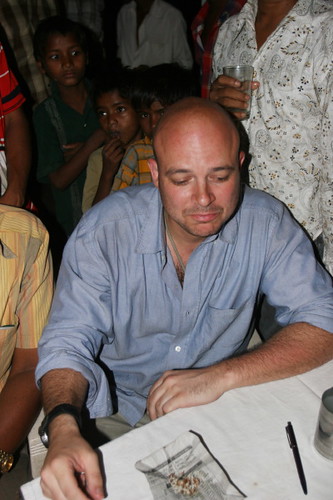
The author, seconds after the delightful ants hit his tongue.

Another classic face.

Neil Samson Katz is a freelance writer and photographer living in New York City. He spent February and March working and traveling in India.

Thursday, July 06, 2006

VIDEO: INDIA'S WAR IN THE WOODS


CHHATTISGARH, India — The 78-kilometer road between Sukma and Konta is nearly deserted. Scores of villages, once bustling with tribal life, are now vacant. Across the rough orange and green terrain of the nearby forests, hundreds of other villages similarly have been abandoned. Tens of thousands of tribal people are simply gone.

This is not war-torn Afghanistan or Sudan. This is central India, where super sleek call centers and software factories have brought millions of poor into the modern middle class.

Watch the Video
Read the Original Story for NJ Star Ledger